Would you build it in this shape?
Tom Blomfield, YC General Partner, asked in a recent YC batch talk: “If you were starting this company today, would you build in this shape?”
That question is hard, even with AI. Old processes are very sticky. Years of work condition people to think in a certain shape. Take my own case. When I joined Amazon in 2015, I spent weeks writing SQL queries to have access to the marketing data I needed. My process would be something like this: I would start by searching for an existing query. I would then adapt it to close gaps. Run it and debug it for a while. Once it was running as expected, I would dump the data into a spreadsheet and only then start my analysis. Over time this process got faster, but a brand new analysis could still eat a day before the real work began.
This whole process changed when I started using AI. Instead of weeks writing SQL queries, I could prompt a model and have my queries running in minutes. It allowed me to start my analysis much faster. Did you notice the problem? Marketers, including myself, got conditioned to think in a spreadsheet. As a result, we use AI to compress the time to complete tasks but we rarely ask whether the task should look different in the first place.
I saw this post on X this week:
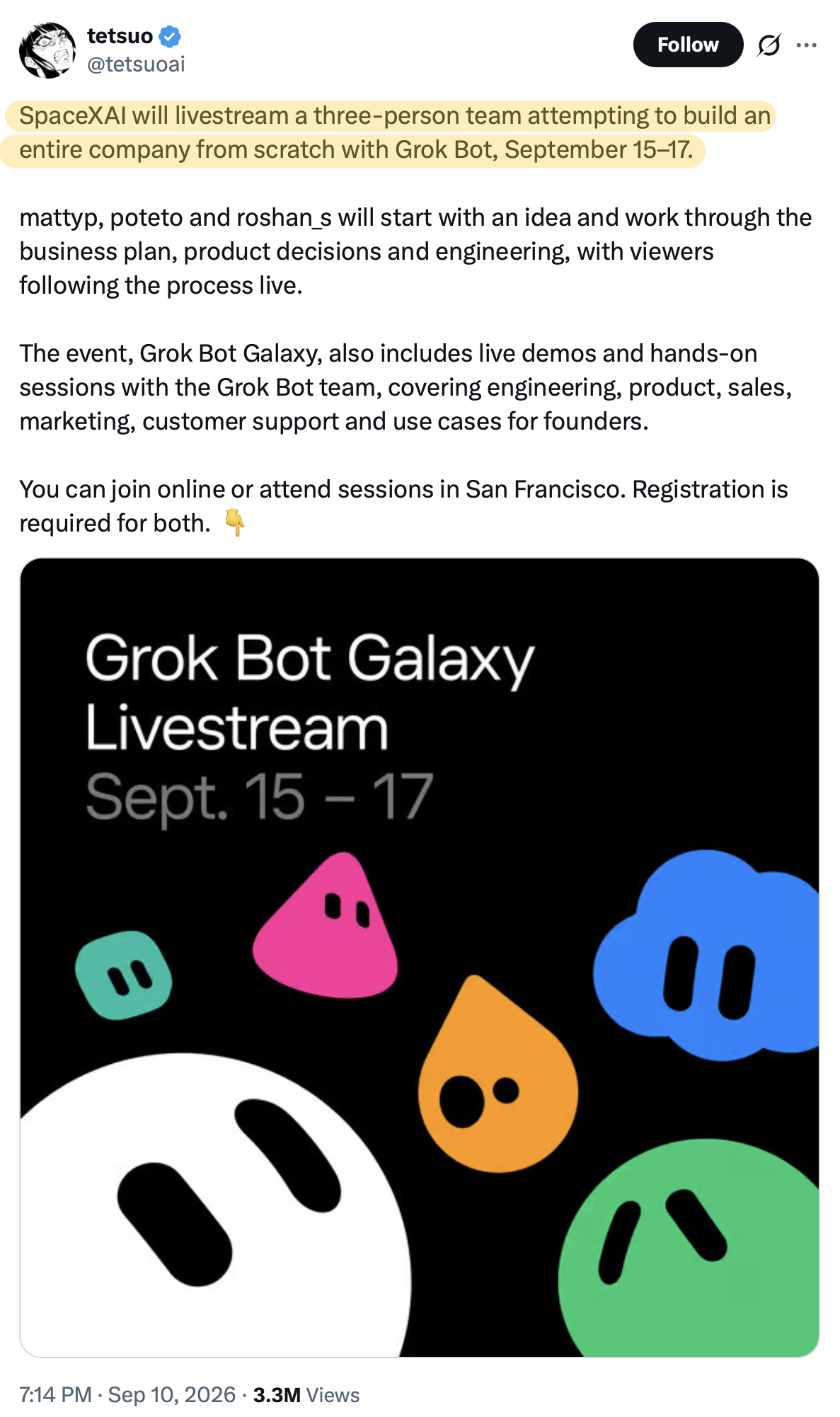
SpaceXAI will livestream a three-person team trying to build a company from scratch using Grok Bot. That’s interesting because starting clean frees you from sticky processes. The team can ask what a company looks like when agents handle most of the work.
My last position at Amazon was as a founding member of an AI pod within the Marketing org. We were three people from Marketing, Engineering, and Product. We weren’t attached to any existing process, so we had a blank canvas to ask what marketing would look like if we were starting today, like Tom proposed.
We automated ~30% of marketing managers’ workflows. In some cases we accelerated the old process. In some cases we changed it completely. Being an independent pod is what made that possible. We were free to simplify as much as possible, shift the burden to agents, and bring teams a different shape that still delivers the same outcome.
That’s not to say we should burn everything to the ground and start from scratch. A lot of what exists today still works. But how do you give people inside a company that blank-canvas freedom without putting them in a special pod?